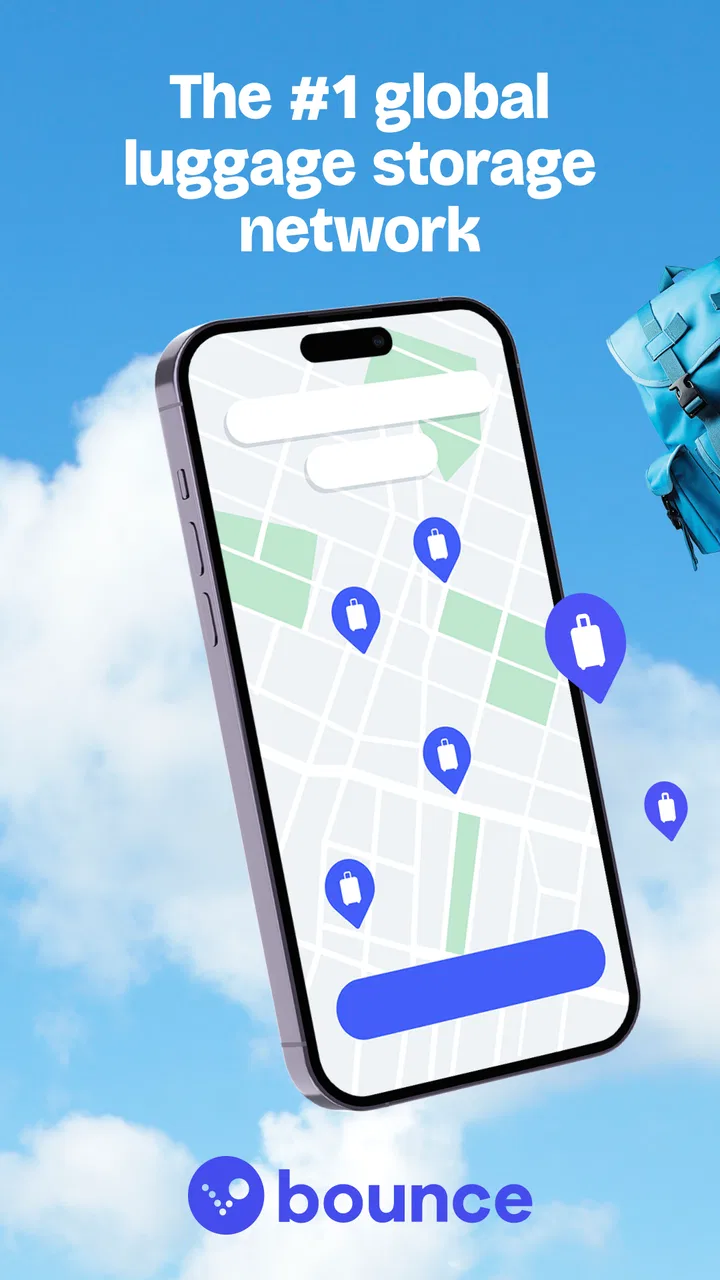
Bounce: Luggage Storage Nearby
- 4.7
- Rating
- 1.00M
- Installs
- Free
- Price

 Analysis by App-foxy
I use travel apps most when I am already carrying too much, running late, or trying to make a short stop feel less complicated. That is where Bounce: Luggage Storage Nearby makes sense. It is a free Travel & Local app from Bounce, Inc. that helps me look for places where I can leave bags temporarily instead of dragging them through museums, restaurants, stations, or unfamiliar streets.
The idea is simple, but the practical value depends on the situation. Bounce is not a trip planner, a navigation replacement, or a magic solution for every luggage problem. Its job is narrower: connect a traveler with nearby luggage storage through a mobile search and booking experience. When I have a few hours between checkout and departure, that focused purpose can be much more useful than a large travel app filled with unrelated tools.
The app has built a substantial audience, with over a million installs and an average rating of 4.7 from around thirteen thousand ratings. Those figures suggest that the basic problem is widely understood and that many travelers find the service useful. I still think the best way to judge it is by looking at the moments when it saves time, the moments when it adds another task, and the details I would check before trusting it with an important bag.
You May Also Like

 Blood Strike: 2.5 Anniversary
Blood Strike’s Loadouts Turn Every Drop Into a Tactical Gamble
A close look at Blood Strike’s custom loadouts: how fast access to signature weapons reshapes its battle royale rhythm, rewards preparation, and narrows the gap between fights.

 Pandora - Music & Podcasts
Pandora’s Music Is Easy to Start, but Harder to Recover
Pandora’s strength is its low-effort path from a seed to a station. Its weak spot is how much confidence it asks you to place in connection, setup, and quiet recovery.

 8 Ball Pool
 Is Built on Rivalries, Rematches, and Routine
A close look at the rivalries, rematches, shared routines, and unanswered safety questions that turn a quick pool match into a persistent mobile community.

 Samsung Music
’s Quiet Strength Is Playing What You Already Own
Its reach comes less from spectacle than from dependable access to a personal library. That simplicity is both the app’s strongest retention engine and its ceiling.

 AccuWeather: Weather Radar
AccuWeather Review: A Quick, Clear Forecast for Everyday Decisions
For everyday plans, the best forecast is the one you can understand quickly. AccuWeather makes rain timing, radar, and local conditions easy to act on, with a few trade-offs.

 Hill Climb Racing
Why Hill Climb Racing Still Turns Crashes Into One More Run
A tiny car, a bumpy hill and one more upgrade: Hill Climb Racing keeps resurfacing because its simple chaos makes every near-miss feel personal.
More From Our News Desk



How Bounce fits into a real travel day
I find Bounce most useful when a travel day involves more than one person and a shared plan, such as meeting after checkout and exploring before a departure. This section looks at how I would fit a bag drop into that kind of day, then turns to the small setup and coordination choices that help keep everyone on the same page.
A practical answer to the checkout gap
My clearest use case is the awkward period after leaving accommodation but before transport. Imagine checking out in the morning, having an evening train or flight, and wanting to explore without carrying a suitcase. With Bounce, I can search for a storage location near the area I plan to visit rather than returning to the accommodation later. That changes the shape of the day: I can choose a café, gallery, shopping street, or meeting point based on where my bag can be left.
The same workflow helps with an early arrival. If a room is not ready, storing luggage nearby can make the first few hours of a trip more comfortable. It is also useful for people attending a concert, sporting event, conference, or day tour when a hotel is too far away and carrying a large bag is inconvenient.
The strongest benefit is not simply finding storage; it is placing storage into the route I already want to take. That distinction matters. A storage point close to a station may be ideal for one traveler, while a location near a neighborhood attraction may be better for another. I would search before committing to the day’s plan, not treat the app as an afterthought.
What the search experience is good at
The app’s central experience is easy to understand: I look for nearby luggage storage, review the available option, and arrange the drop-off through the service. That is much more direct than searching the web for “left luggage” and then comparing scattered business pages, opening hours, and instructions manually.
The nearby-search approach is particularly helpful in an unfamiliar city. I do not need to know the local terminology for luggage lockers or guess which businesses might accept bags. I can begin with the place I am standing or the destination I am heading toward. For a traveler who has just arrived and is working from a phone, that reduction in searching is meaningful.
Still, I would not select the first result automatically. Distance on a map is only one part of the decision. I would consider the walking direction, the size and number of bags, the drop-off and collection times, and whether the location fits my route. The closest point can be a poor choice if it requires a detour or closes before I return.
Useful workflows beyond the obvious booking
One less obvious way to use Bounce is as a route-planning filter. Before choosing a restaurant or attraction for the middle of the day, I can check whether storage is available near that area. This reverses the usual process of finding a storage point first and then wandering around it. It is a small change, but it helps when I want the luggage stop to support the itinerary rather than dictate it.
Another practical habit is to search twice: once while planning and again on the day of use. Planning early helps me understand the geography and avoid building an itinerary around a location that is inconvenient. Checking again before leaving the accommodation lets me react to changes in timing or choose a better point closer to the next part of the trip.
I also find it sensible to keep the booking details easy to reach before arriving at the storage point. In a busy station or crowded street, repeatedly searching through messages is unnecessary friction. A screenshot or saved confirmation can make the handoff smoother, although I would still rely on the current booking information when anything has changed.
How it compares with lockers, hotels, and informal alternatives
Traditional station lockers remain a strong alternative when I am already inside a station and only need short-term storage. They can feel immediate and familiar, especially for a small bag. The weakness is availability: a locker is not guaranteed to be free when I arrive, and it may not suit larger luggage. Bounce is more useful when I want to search before walking there or when my destination is away from the station.
Leaving bags at a hotel or accommodation can be simpler if the property offers that service. It avoids handing luggage to another business and may be the best choice when I am returning to the same place later. Bounce becomes more attractive when I have checked out, arrived before check-in, or need storage somewhere else in the city.
Asking a café, shop, or restaurant informally is usually less predictable. Even if an employee agrees, I may not have a clear process, consistent opening hours, or a convenient way to handle the return. Bounce provides a more organized travel-specific route, but that convenience comes with the responsibility of reading the location details carefully rather than assuming every partner works identically.
For travelers who only need a bag-free hour near a station, a locker may be faster. For a full afternoon, a location chosen through Bounce can be more flexible. Neither option wins universally; the right choice depends on certainty, route, bag size, and how fixed the return time is.
The current app and its place in the product’s evolution
Bounce was released on February 2, 2019, and the current version is 4.387.0. That version number indicates an actively maintained product rather than a one-off directory, but I would not treat a newer version number as proof that every travel edge case has been solved. In a service that depends on real locations, the quality of the experience is shaped by both the app and the individual storage point.
What I notice in the current product direction is a focus on making a worldwide luggage storage network usable from a phone. The evolution is most valuable when it reduces the small uncertainties around searching, selecting, and returning for a bag. For existing users, that means the familiar basic idea remains intact while the app continues to serve a broader range of travel situations.
That continuity is helpful. I would not want a luggage app to become overloaded with hotel discovery, itinerary planning, or social features. The more important progress is practical: clearer choices, a smoother booking path, and information that helps me decide whether a location really fits my day. Those are the improvements that affect a rushed traveler more than cosmetic changes.
What existing users should expect from the update path
Someone who already uses Bounce should find the app most valuable when treating it as a planning tool rather than an emergency directory. The current version is worth keeping up to date because travel services depend on current location information and a reliable mobile flow. I would update before a major trip, then test the sign-in and booking access while I still have stable internet.
At the same time, an update cannot remove the need for judgment. Opening hours, walking distances, local congestion, and a delayed train can still affect the plan. I would leave a buffer between collecting my luggage and boarding transport. If the bag is essential for the next step of the trip, I would avoid choosing a location that leaves only a few minutes of margin.
There is also a useful distinction between app convenience and service confidence. A polished search screen can help me find a place, but I still need to inspect the address and instructions. Existing users who already know the service may move quickly through the process; I would slow down whenever the location is unfamiliar or the timing is tight.
Where the experience still has limits
The biggest limitation is that Bounce cannot make a storage point appear exactly where I want it. Availability and convenience depend on the city and the particular area. A search may show options, but the best one for my route could still require walking with luggage or changing plans. In a small town or a less tourist-focused area, I would be especially cautious about assuming that nearby storage will be plentiful.
The app also adds a layer between me and the physical handoff. That is useful for discovery and organization, but it means I need to understand the instructions before arriving. If I am carrying fragile equipment, medication, work materials, or anything irreplaceable, I would think carefully about whether temporary third-party storage is appropriate. The app’s convenience should not replace common-sense decisions about what I pack and where I leave it.
Timing is another source of friction. A storage booking only helps if the drop-off and collection windows match the actual day. Delays, spontaneous itinerary changes, and a late departure can turn a convenient plan into a stressful one. I would not use the shortest possible window when traveling with children, catching a connection, or navigating a city I do not know.
People who dislike advance planning may also find the service less satisfying than a locker. Bounce is better when I can compare options and choose deliberately. If I am already at a station with a free locker directly beside me, opening another app and arranging storage may be unnecessary. The service is not automatically better just because it is digital.
Who should use it and who should skip it
I would recommend Bounce to city travelers with a checkout gap, visitors arriving before accommodation is ready, and anyone whose luggage makes a walking-heavy itinerary unpleasant. It is also a good fit for travelers who prefer to make a decision before reaching the storage point instead of hoping a locker will be available.
I would be more selective for a very short stop, a rural destination, or a journey with an extremely tight connection. In those cases, the hotel, station locker, or a direct luggage facility may be simpler. Travelers carrying valuables or items that need special handling should also consider whether this type of service matches their comfort level before booking.
The age rating is Everyone, which suits the app’s general travel purpose, and it is free to install. That makes it easy to keep available for occasional trips even if I do not use it every week. The important question is not the installation cost; it is whether the available storage option, timing, and route make sense for the particular day.
Questions I would settle before leaving my bag
Before booking, I would confirm exactly where the storage point is rather than relying only on a broad neighborhood label. I would check the route from my arrival point, estimate the walk with luggage, and make sure the collection trip ends near the next part of my itinerary. This is especially important in large stations, where a location that looks close on a map can involve several entrances or levels.
I would also decide what “nearby” means for my group. A ten-minute walk may be easy with a backpack but tiring with several suitcases, a stroller, or a mobility limitation. A slightly farther point along the planned route can be the better choice if it avoids backtracking. The app helps me discover options, but I still need to evaluate them as a traveler on foot.
For collection, I would plan around the latest realistic return time rather than the ideal one. If dinner runs late or transport is delayed, a narrow schedule creates pressure. I would keep the booking information accessible and allow time to identify the entrance, complete the handoff, and walk onward. That preparation answers the practical question many first-time users have: not merely whether storage exists, but whether retrieving the bag will remain easy after a long day.
What I would like to see watched closely
As Bounce continues to evolve, I would pay attention to how clearly it communicates the differences between storage points. Travelers need more than a pin on a map; they need confidence that the location suits their luggage, timing, and route. Improvements that make those comparisons quicker would have a direct effect on real-world usefulness.
I would also watch how well the app handles changing plans. Travel is rarely neat, and a delayed arrival or an earlier departure can affect the value of a booking. A strong future direction would be making adjustments and instructions feel as clear as the original search, without turning the interface into a complicated travel-management system.
Finally, I would judge future releases by whether they reduce last-minute uncertainty. The most valuable progress is not adding distractions around the core service. It is helping me answer three questions quickly: where can I leave the bag, does the place fit my route, and can I collect it comfortably when I need it?
My final take for travelers
Bounce solves a specific problem well: it gives me a practical way to search for luggage storage while moving through a city. I like it most when I have several free hours between accommodation and transport, because it lets me build a day around places I actually want to visit instead of around the location of my hotel.
It is not a substitute for checking timing, distance, and suitability. A station locker can be faster, a hotel can be simpler, and a different option may be wiser for valuables or a very tight connection. Used thoughtfully, though, Bounce turns luggage from a constant physical burden into a planning detail.
For me, that is enough to keep it installed for travel. The app is free, its purpose is clear, and its worldwide network gives it more usefulness than an ordinary search for lockers. I would recommend it to a friend with one condition: choose the storage point as carefully as you choose the attraction you are visiting. When the location fits the route, Bounce can give an entire travel day noticeably more freedom.
FAQs for Bounce: Luggage Storage Nearby
01What is Bounce: Luggage Storage Nearby and how does it work?
Bounce: Luggage Storage Nearby is an app designed to help travelers find secure locations to store their luggage while they explore cities. By partnering with local businesses, Bounce offers convenient drop-off points. Users can search for nearby storage locations, book a spot, and drop off their luggage, ensuring it’s safe while they enjoy their day bag-free.
02How secure are the storage locations offered by Bounce?
Security is a top priority for Bounce. All partner locations are vetted to ensure they provide a safe environment for your belongings. Each item is secured with a tamper-proof seal, and insurance coverage is included for added peace of mind. This means you can confidently explore without worrying about your luggage.
03What are the costs associated with using Bounce?
The cost of using Bounce varies depending on the location and duration of storage. Generally, the service is affordably priced, making it a cost-effective option for travelers. The app provides a transparent pricing model, allowing users to see costs upfront before booking, ensuring there are no hidden fees or surprises.
04Can I cancel or modify my booking with Bounce?
Yes, Bounce offers flexibility with your bookings. Users can easily modify or cancel reservations through the app. However, it’s important to check the specific cancellation policy for each location, as terms may vary. Typically, cancellations can be made without penalty if done within the stipulated time frame.
05Is Bounce available in all cities worldwide?
While Bounce is rapidly expanding, it is not available in every city worldwide. The app is currently operational in major cities across several countries, with plans to extend its reach. Before traveling, users can check the app or website to see if their destination is covered, ensuring they can plan accordingly.
Pros
- Convenient locations for easy access.
- Secure storage with insurance coverage.
- User-friendly app interface.
- Affordable pricing options available.
- Fast booking process.
Cons
- Limited storage duration options.
- Not available in all cities.
- Customer service response time varies.
- App notifications can be inconsistent.
- Requires internet connection for use.

Bounce: Luggage Storage Nearby
Gallery